
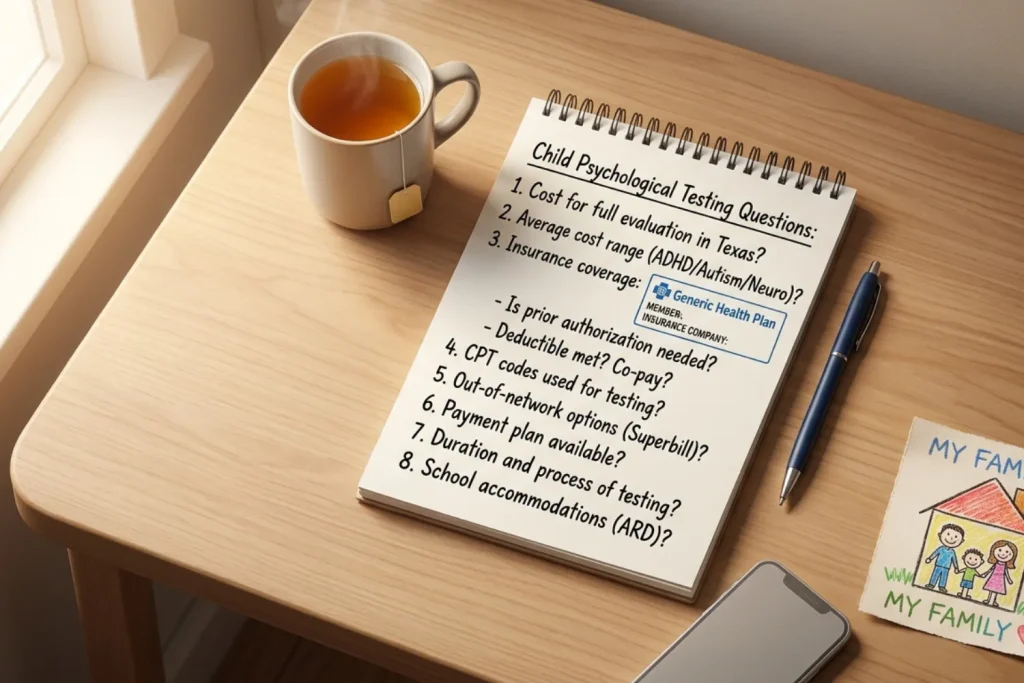
Psychological testing is usually billed by the hour, so the cost depends on how many questions your child’s testing requires. Many insurance plans cover part of it when it’s tied to a diagnosable concern, but coverage varies by plan, and educational testing is often excluded. Texas public schools also offer a no-cost evaluation, which is a separate route.
Cost is one of the biggest reasons parents delay testing, and one of the least clearly explained. Here’s how to make sense of it.
What you’re actually paying for
An evaluation is more than the hours your child spends at the table. It includes the parent interview, test administration, scoring, interpretation, report writing, and the feedback session. One family-services center estimates that a comprehensive assessment involves about 20 hours of work, roughly half of it with your child and half on scoring, report writing, and feedback. Our guide on how long child psychological testing takes breaks down where those hours go.
Clinics often bill under standard procedure codes (CPT codes). University clinic guidance, for example, lists 90791 for the diagnostic interview and 96130, 96131, 96136, and 96137 for testing. Knowing the codes helps you ask your insurer the right questions.
To see how hourly billing adds up, one Virginia hospital program publishes its fees: its learning-disorder evaluation is listed at $2,510 for 12.5 hours of psychological testing, on top of a $350 intake interview. That’s one example from another state, not a Texas price. Fees vary widely by clinic, region, and the type of evaluation. [PPTS: add your fee range or per-evaluation pricing here.]
Three common ways clinics handle payment
- In-network billing. The clinic bills your insurance directly, and you pay your copay, coinsurance, or deductible.
- Out-of-network with a superbill. You pay the clinic, then submit an itemized receipt (a superbill) to your insurer for possible reimbursement. Clinics that work this way note that coverage isn’t guaranteed, and some advise getting authorization before the first appointment.
- Self-pay. You pay the clinic directly, sometimes as a package.
What insurance may and may not cover
Often covered, in part: Testing tied to a diagnosable mental health or medical concern, such as ADHD, anxiety, or autism. Some practices tell families to ask about out-of-network benefits for these testing codes and about any preauthorization requirements.
Often not covered: Purely educational testing. A Virginia program, for instance, separates its charges and notes that educational testing is not covered through insurance. If your child needs academic testing for a learning difference, ask the clinic which parts are billed to insurance and which are self-pay.
What the law says: Federal parity law means that if your plan covers mental health benefits, it can’t impose financial requirements like copays, or limits like visit caps, that are more restrictive than those for medical and surgical care. The same page explains that the law does not itself require plans to offer mental health benefits. So parity helps with how benefits are applied, but it doesn’t guarantee that testing is covered.
In Texas, autism-related coverage is addressed in Insurance Code §1355.015, which includes screening at 18 and 24 months and notes that coverage can still be subject to deductibles, copayments, and coinsurance. The rules for diagnosis and treatment coverage have been the subject of legislative proposals, so confirm what applies to your plan with your insurer.
The free option: school evaluation
Texas public schools must evaluate students suspected of having a disability, and that route costs families nothing. The Texas Education Agency states that a special education evaluation is free, at no cost to you. We cover how to request one, and how it differs from a private evaluation in our guide to school vs. private evaluation in Texas.
If a school district ends up paying for an independent evaluation, TEA’s guidance adds that districts may not require parents to bill their private insurance for it.
A school evaluation and a private one answer different questions. School evaluations focus on eligibility for special education services. Private evaluations often go deeper on diagnosis and recommendations across home, school, and therapy.
What to ask your insurance company
Call the number on the back of your card and ask for behavioral or mental health benefits:
- Does my plan cover psychological testing for a child? Is there a diagnosis requirement?
- Is [PPTS] in-network? If not, what are my out-of-network benefits?
- Do I need preauthorization for testing? Which CPT codes: 90791, 96130, 96131, 96136, 96137?
- What is my deductible, and how much has been met?
- What are my copay or coinsurance and my out-of-pocket maximum?
- Is there a limit on the number of testing hours per year?
- Is my plan fully insured or self-funded by my employer? (This can change which rules apply.)
Write down the date, the representative’s name, and a reference number.
What to ask the clinic
- What is the total fee, and what does it include?
- Do you bill insurance, or provide a superbill?
- Is any part, like educational testing, billed separately?
- What happens if my child needs another session?
- Do you offer payment plans?
Ways to make it more manageable
- Ask whether your HSA or FSA can be used. Your plan administrator can confirm.
- Ask about payment plans or packages.
- Start with a consultation to narrow the testing needed, which may reduce unnecessary hours.
- If the main need is school support, ask whether the school evaluation could meet it first.
Frequently asked questions
Is psychological testing for children covered by insurance in Texas?
Sometimes. Coverage depends on your plan, the reason for testing, and the provider’s network status. Verify before you schedule.
Can I get reimbursed if the clinic is out of network?
Possibly. Many plans reimburse part of the cost with a superbill, but it isn’t guaranteed.
Is the school evaluation really free?
Yes. Texas public schools provide special education evaluations at no cost to parents.
Will insurance cover a learning disability evaluation?
Often, the diagnostic portion may be covered, while academic testing is more likely to be self-pay. Ask for a breakdown.
Questions about fees or insurance for your child’s evaluation? Contact our San Antonio team or call 210-797-7142, and we’ll walk you through your options before you commit. Start with our guide to what psychological testing for children is.